
- Published on
MotionClone: Training-Free Motion Cloning for Controllable Video Generation(CVPR2025)
- Authors

- Name
- Minkyoung Shin
MotionClone: Training-Free Motion Cloning for Controllable Video Generation
diffusion 을 활용한 video generation 에 대해 기본적으로 알아야 하는 개념들에 대해 몇개 짚고 시작해보려한다.
Temporal attention :
시간 순서로 주어진 비디오 프레임들 사이에서, 각 프레임 또는 시점이 얼마나 중요한지를 학습하는 어텐션 메커니즘을 의미
- 예: = 시점 t의 중요도 (attention weight)
Motion Representation
motion representation 이라는 개념은 시간 흐름에 따른 물체나 장면의 변화, 즉 움직임을 수치화하거나 특징 벡터로 표현한 것이다.
- temporal attention weights는 어떤 시점의 변화가 중요한지를 모델이 학습한 값.
- 따라서, 이 가중치 자체를 "어떤 시점에서 모션이 크게 일어난다", "특정 행동을 인식하는 데 중요한 순간이다" 등의 정보로 사용하면 motion representation
어떤 특정 프레임에서 이 행동이 중요하게 일어났는가를 weight 로 매겨서 여기에 attention 을 많이 주는 방식
Preliminaries
Diffusion 모델의 sampling 경로(trajectory)는 원래는 확률적이지만, 여기에 external guidance (예: label, 모션 정보 등)를 추가하면 원하는 방향으로 생성 이미지를 유도할 수 있다는 것을 가정한다.
noise prediction 결과 를 다음과 같이 수정한다.
식이 어떻게 구성되어있는지 확인해보면,
| 기호 | 의미 |
|---|---|
| 현재 timestep t에서의 noised latent | |
| 조건 c (예: 텍스트 프롬프트)하의 노이즈 예측 | |
| Unconditional 노이즈 예측 (e.g., null 텍스트) | |
| s | Classifier-free guidance weight |
| Energy function: label y 기반 추가 control 하는 목적 함수 | |
| energy guidance strength | |
| Noise schedule의 하이퍼파라미터 (DDPM의 알파바) |
기본 noise prediction:
Classifier-free guidance (CFG):
- 조건 프롬프트를 더 강하게 반영하게 만드는 방법 (Ho & Salimans, 2022)
Custom energy-based guidance:
- label y나 모션 정보 등 외부 정보 기반으로 정의된 에너지 함수의 gradient를 통해 latent 방향 조절
전체 noise prediction 보정 결과:
- 위 세 항을 모두 합쳐 샘플링 경로를 의도한 방향(= y) 으로 유도
- Diffusion 모델은 timestep t에서 다음 latent를 noise prediction을 통해 점진적으로 denoise하며 샘플을 생성한다.
- 그런데 gradient-based energy guidance를 통해 원하는 속성(label y)을 만족하도록 latent 방향을 미세 조정할 수 있음을 보이는데,
- 는 energy gradient가 noise space에 있도록 스케일을 맞추기 위한 보정 (DDPM의 노이즈 구성: )
본 논문에서 사용한 sampling 과정에서의 수식은 기존의 classifier-free guidance와 energy-based guidance를 결합한 형태로 샘플링 과정에서 latent에 추가적인 constraint을 걸어, label이나 모션 같은 속성을 더 정확히 반영하고,
는 “지금 생성되고 있는 내용이 label y와 얼마나 잘 맞는지를 측정한 에너지 함수” 로부터 유도된다.
Observation: 모든 frame의 행동이 다 중요할까? X
기존 방식은 plain control로 진행 → 이를 primary control 로 다룸
Plain Control
- 기존 방식은 reference 비디오의 모든 temporal attention weight를 생성 중인 비디오에도 균등하게 강제 적용하는 방식을 사용했었다.
- 문제점:
- 영상 전반의 rectangular attention weight에는 실제 의미 있는 모션뿐만 아니라 노이즈나 아주 미세한 움직임도 포함됨 → 이를 전부 맞추다 보면 모션 신호가 약해져서 핵심적으로 전달해야하는 행동을 따라하지 못한다.
- 결과적으로 강한 모션 패턴만 일부 전달되고, 정확한 모션 클로닝은 실패하는 경우가 많다. 논문에서는 고양이 걷는 동작, 탱크의 방향 전환 정도만 부분적으로 복제된다고 언급합
Primary Control (본 논문에서 사용)
전체 attention map이 아닌, sparse temporal attention mask로부터 가장 중요한(principal) weight들만 골라 constraint를 건다.
방식
reference 비디오의 temporal attention map에서 모션을 주도하는 주요 컴포넌트(large weight)의 부분 집합을 찾는다.
생성 중인 비디오 역시 이 중요 weight들만 맞추도록 유도 (아래 식과 같은 mask M 적용) .

이로인한 이점은
- 모션 관련 신호에만 집중하고 불필요한 노이즈/미세모션은 무시 → 모션 클로닝 성능이 뚜렷하게 향상됨.
- 논문에서 “primary control over sparse temporal attention map significantly boosts motion alignment”라고 강조하고 있다.
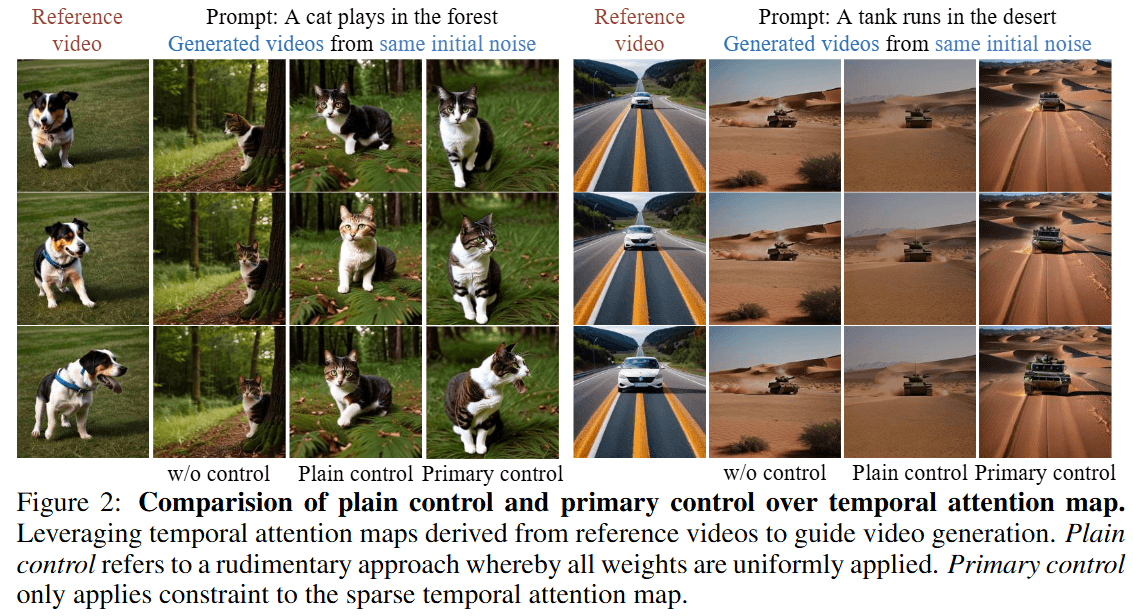
기존 방식의 plain control 시의 video generation 결과와 primary control을 적용했을 때의 video generation 결과를 확인해보면, 확실히 reference로 준 video의 행동이라던지 카메라 무빙을 잘 따라가는 모습을 확인할 수 있다.
Motion Representation
Temporal attention map based motion representation
1. Temporal Attention Map 정의
: 참조(reference) 비디오에서 t 스텝에서 얻어진 temporal attention map.
각 위치 p, 프레임 간 i,j 쌍에 대해 는 프레임 i와 j 간의 연관성을 나타냄.
Softmax를 거쳤기 때문에
즉, 프레임 i가 프레임 j에 얼마나 주의를 기울이는지를 표현함.
2. Motion Guidance via Attention Distance (Eq. 4)
- 생성된 비디오의 attention map 이 참조 영상의 attention map 에 가깝도록 유도.
- : sparse temporal mask로, 어떤 위치에서 attention을 얼마나 강하게 맞춰야 하는지 결정함.
- 이면 Plain Control: 전체 attention map에 대해 제약을 가함.
- Sparse할수록 필요한 부분만 맞추도록 유도 (Primary Control).
3. Sparse Mask 생성
- : attention 값이 높은 top-k 프레임 인덱스 j들의 집합.
- 결과적으로 는 중요한 모션 상호작용만 유지하는 희소한 마스크가 됨.
- k=1이면 가장 강한 attention 연결 하나만 사용 → 매우 희소(sparse).
4. Sparse Representation 도입
문제점:
- 실제 비디오에서 을 얻으려면 비싼 inversion 과정이 필요.
- 시간 축마다 다르게 계산되므로 공간/시간적 비용 매우 큼.
해결방법:
- 고정된 특정 시점 (예: t=200~600)에서만 attention 정보를 수집.
- 이때,
- 즉, 를 sparse mask와 곱해 중요한 모션 부분만 추출.
- 이렇게 구성한 는:
- 매우 희소하고 (sparse),
- 단 한 번의 노이즈 추가 → denoising으로도 쉽게 얻어짐.
- 전체 비디오가 아니라 한 시점만 사용하므로 비용 절감 + 성능 유지 가능.
여기서 주의할 점은
초반 denoising 단계 (예: )에서는 motion representation 가 실제 모션(예: head-turning)과 불일치할 수 있음.
→ 너무 noisy한 단계에서는 motion 정보가 왜곡됨.
따라서 적절한 t 범위 (예: t=200~600)를 선택하는 것이 중요하다.
| 항목 | 의미 |
|---|---|
| 참조 영상의 시점 t에서 temporal attention map | |
| 생성 중인 영상의 attention map | |
| top-k attention만 남긴 sparse mask | |
| g | attention 차이를 통한 모션 제약 energy |
| 중요한 attention만 추출한 모션 신호 | |
| 한 시점의 sparse 모션 표현 (적은 비용으로 추출 가능) |
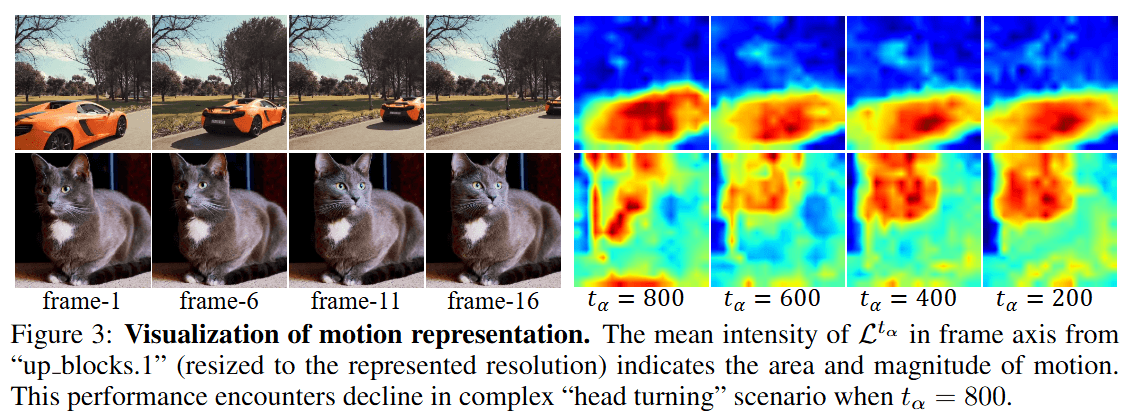
이렇게 motion representation 방식을 적용하게 되면, 행동에 있어 중요한 frame을 더 attention 하게 됨으로써 카메라의 무빙이라던지, 동물의 움직임 등 행동을 condition 으로 줄 수 있게 된다.
Motion Guidance
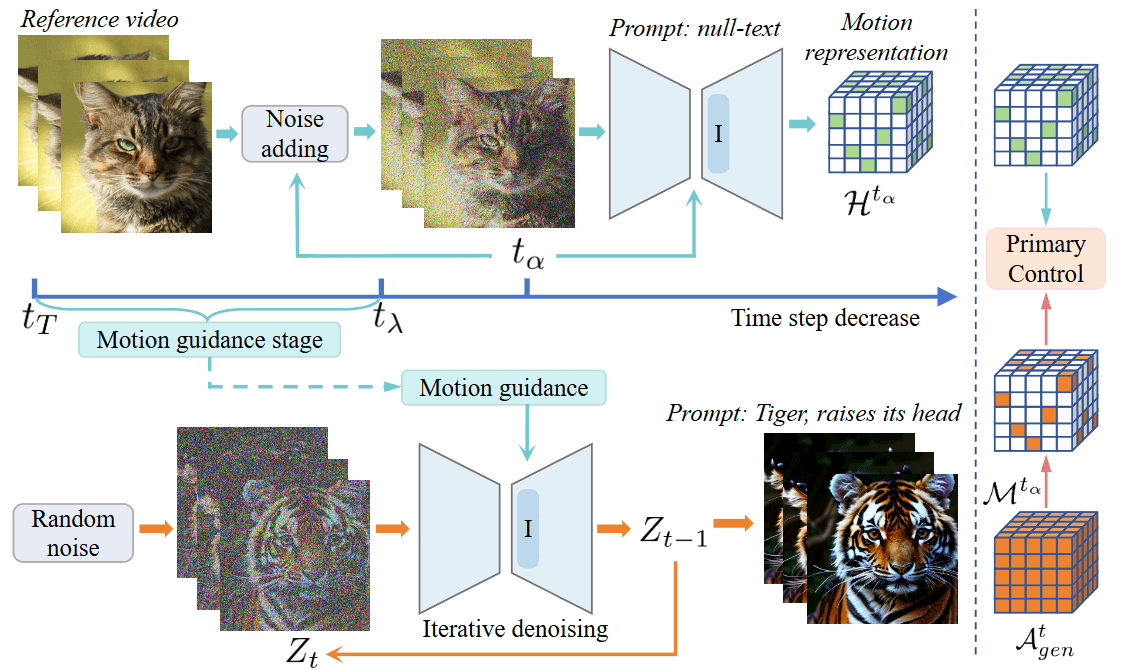
motion guidance를 주는 방식을 알려면 motionclone 의 전반적인 pipeline을 알아야하는데,
처음 Reference video는 → motion representation 생성하고
Video generation 에서는→ pre-trained diffusion 모델 + motion guidance 를 사용한다.
즉, motion guidance는 초기 단계에만 적용한다.
Motion representation 추출
"Given a real reference video, the corresponding motion representation is obtained by performing a single noise-adding and denoising step."
- 영상 전체를 복잡하게 inversion 하지 않음!
- 대신,
- ① 원본 영상을 특정 시점 까지 노이즈 추가하고
- ② 한 번 denoising을 수행해서 attention map을 뽑아냄
- 이 과정을 통해 motion representation 를 얻음
즉, 단 1-step denoising으로 저렴하고 효율적인 모션 특징 추출 가능
생성 과정: 초기 latent → iterative denoising
"During the video generation process, an initial latent is initialized from a standard Gaussian distribution and subsequently undergoes an iterative denoising procedure via a pre-trained video diffusion model..."
- 생성은 diffusion 모델의 기본 구조를 따름:
- 무작위 노이즈 (Gaussian) → 여러 단계 denoising → 비디오 샘플
- 여기에 두 가지 guidance가 들어감:
- Classifier-free guidance (CFG): 텍스트 조건 (예: "a cat jumping")
- Motion guidance: 참조 비디오 기반 모션 정보
시간 흐름에 따른 이미지 특징 결정 과정
"Given that image structure is determined in the early steps of the denoising process (Hertz et al., 2022), whereas motion fidelity primarily depends on the structure of each frame..."
- 기존 논문 (Hertz et al., 2022)에 따르면:
- 초기 denoising 단계 (t 큰 값): 이미지의 전체 구조, 윤곽이 정해짐
- 후기 단계 (t 작은 값): 디테일 조정, 텍스처 보정
- 즉, motion fidelity는 이미 각 프레임의 구조가 정해지고 난 이후에 fine-tune 하기 어렵다는 뜻
Motion guidance는 "초기 denoising 단계에만" 적용
"motion guidance only involves the early denoising steps, allowing for sufficient flexibility for semantic adjustment..."
- Motion guidance를 너무 뒤까지 강제하면:
- 디테일한 텍스트 조건 (예: "wearing a red hat") 반영을 방해할 수 있음
- 그래서:
- 초기 단계 (e.g., t=800 ~ t=400)에만 motion guidance를 적용해서
- 구조적인 모션만 가이드하고
- 이후 단계는 자유롭게 텍스트와 세부 디테일 맞추도록 둔다.
결과적으로 motion fidelity + textual alignment 에 뛰어남
"...thus empowering premium video generation with compelling motion fidelity and precise textual alignment."
- 이 구조 덕분에:
- 참조 영상과 정확히 비슷한 모션 복제 (motion fidelity) 달성
- 동시에 텍스트 조건에 맞는 외형/배경/디테일 표현 (textual alignment) 도 잘 된다는 것을 확인할 수 있다.
Results
motionclone 에 대한 결과를 확인해보면, 확실히 카메라 무빙이라던지, 행동들이 reference video를 잘 따라가는 모습을 보인다. 실제로 github에 있는 weight download하여 inference를 진행해보면, camera top-down zoom-in 등 다양한 자연물에 대한 행동 묘사를 상당히 잘하는 모습을 확인할 수 있다. (메모리 소요도 AV100 기준 15GB, 1분 정도 밖에 걸리지 않는다)
행동에 대한 다양한 control 이라던지, multi-object에 대한 video reference를 주는 방식들로 연구 전개가 지속될 듯 하다.
이 모델에 대한 더 자세한 내용은, 본 논문을 참고하면 된다 ! :
📄 Read the paper on arXiv