
- Published on
Anomaly Detection with Domain Adaptation(CVPR2023)
- Authors

- Name
- Minkyoung Shin
Anomaly Detection with Domain Adaptation
Semi-supervised anomaly detection 문제는 target 도메인에서 라벨링된 데이터가 제한적인 상황에서 정상과 비정상 데이터를 분류해야 한다는 점에서 어려움이 크다.
특히, source 도메인에서는 정상(normal) 데이터만 사용할 수 있고, target 도메인에서도 일부 정상 데이터만 활용 가능한 상황에서 anomaly를 탐지해야 한다는 점에서, domain adaptation 기반의 접근이 필요하다.
이러한 문제 설정 하에서 본 논문은 IRAD(Invariant Representation Anomaly Detection) 구조를 제안하며, shared encoder와 private encoder를 결합한 adversarial training 구조를 통해 feature를 나누고자 하였다.
Overall Method
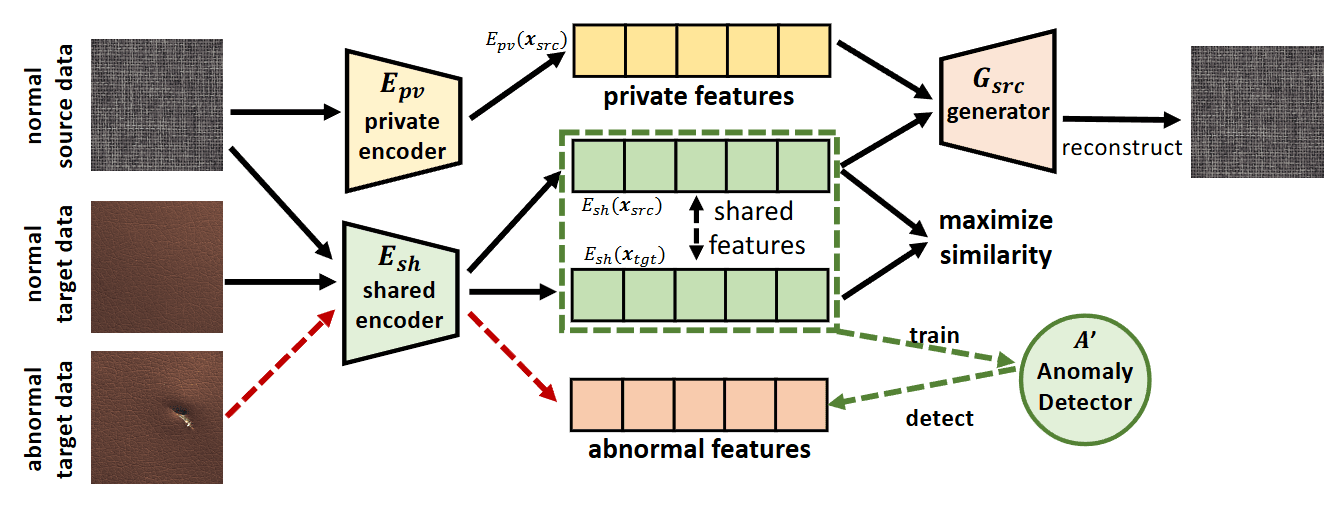
이 구조는 다른 semi-supervised 방식과 동일하게 feature extraction 과정 중 domain adaptation을 결합하여 target 도메인의 anomaly detection 성능을 향상시키는 것이 목표.
Source data는 ImageNet으로 pre-trained된 ResNet-50을 통해 feature를 추출하며, normal 데이터만 사용된다.
Target 도메인은 normal, abnormal 데이터를 모두 포함하되, 학습 시에는 normal 데이터만 활용하며, 이 역시 ResNet 기반 shared encoder를 통해 feature를 추출하게 된다.
이러한 shared feature와 source domain 에 특징된 feature를 함께 활용하여 generator를 통해서 target-like 이미지를 생성하고, 이를 통해 최종적으로 anomaly detection을 수행한다.
Discriminator는 사전학습되지 않은 ResNet-18을 기반으로 이루어져 있다.
Problem Statements
본 논문이 다루는 문제는 다음과 같다:
- Settings: source 도메인과 제한된 target 도메인 데이터가 주어짐
- Limitations: 학습 시에는 source와 target의 normal data만 사용 가능함
- Test Env: test set은 normal과 abnormal이 혼합됨
- Metric: AUROC을 사용하여 anomaly detection 성능을 평가함
Method
Shared + Private Encoder
기존의 domain adaptation 연구에서는 도메인이 달라져도 변하지 않는 공통된 feature (domain-invariant feature) 를 추출하는 방식이 일반적이다.
IRAD는 이러한 기존 방식에 기반을 두면서도, 공통 feature와 domain-specific feature를 명확히 분리하는 데 중점을 둔다.
이를 위해 shared encoder와 더불어 private encoder를 도입하였으며, 특히 source 도메인에 대해 특정된 정보를 뽑아내기 위해 adversarial training 구조를 사용하였다.
Adversarial Loss
Generator에서는 다음과 같은 방식으로 학습이 진행된다:
- 공통 feature + source-specific feature (from source) → 하나의 이미지 생성
- 공통 feature (from target) + source-specific feature → 또 하나의 이미지 생성
이 둘은 discriminator를 통해 같은 이미지처럼 보이도록 유도된다. - random vector + shared feature (from source) → 추가로 하나 생성하여, private encoder가 과도하게 영향력을 갖지 않도록 제어한다.
Discriminator는 이 세 가지 이미지와 실제 source 이미지를 구분하도록 학습되며, 이 과정을 통해 target domain에 align된 feature 공간을 구축할 수 있게 된다.
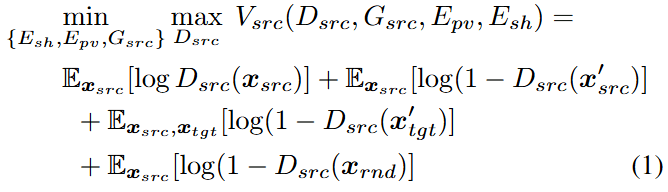
Adversarial Loss는 생성된 이미지가 진짜 source 이미지처럼 보이도록 학습하는 데 핵심적인 역할을 한다. GAN의 기본 아이디어에 기반하여, Generator는 Discriminator를 속이도록 학습되고, Discriminator는 진짜와 가짜 이미지를 구분하는 역할을 한다.
다음은 IRAD 논문에서 정의된 adversarial loss 함수이다:
x'_{src}는 source에서 생성된 복원 이미지이다.
x'_{tgt}는 source의 private feature와 target의 shared feature로부터 생성된 이미지이다.
x_{rnd}는 무작위 z와 source shared feature로부터 생성된 이미지이다.
이러한 다양한 조합의 생성 이미지를 통해 Discriminator는 더 강력하게 훈련되고, Generator와 Encoder는 더 정밀한 생성 결과를 출력할 수 있도록 학습된다.
Adversarial Loss는 모델이 보다 실제와 유사한 이미지를 생성하게 만들며, anomaly detection의 신뢰도를 높이는 데 기여한다.
Cycle Consistency Loss
Cycle Consistency는 생성된 이미지가 원래 입력을 재현할 수 있도록 보장해준다. 이는 모델이 실질적인 변환만을 수행하고, 의미 있는 feature 공간을 학습하게 만드는 데 도움이 된다.
Source에서 생성된 x'_{src}는 다시 encoder에 통과되어 original x_{src}와의 유사도를 유지하도록 학습된다.
마찬가지로, x'_{tgt} 역시 target 스타일을 유지하면서도 source 기반의 생성 결과가 되도록 설계된다.
Cycle consistency loss는 다음과 같이 표현된다:
이 손실은 기존 GAN 기반 모델들이 고차원에서 발생하는 mode collapse 또는 reconstruction fail case를 완화하는 데 중요한 역할을 한다.
Additional Loss - Disentanglement Loss, Similarity Loss
shared encoder와 private encoder가 서로 다른 특징을 추출해야 하기 때문에, 각 encoder의 역할을 명확히 분리하는 목적의 추가적인 loss term을 도입하였다. Disentanglement Loss는 공통 feature와 private feature의 내적을 최소화함으로써 서로 다른 정보만을 담도록 학습된다.
Disentanglement Loss
Similarity Loss
Similarity Loss는 Source와 target의 shared feature가 유사한 방향을 갖도록 유도하기 위해 두 벡터의 내적을 최대화하는 방향으로 학습된다. 이는 target 데이터가 적은 상황에서도 공통 feature space를 효과적으로 구축하기 위한 핵심 요소이다.
더 자세한 내용은, 본 논문을 참고하면 된다 ! :
📄 Read the paper on arXiv